Robotus pubgensis · the lobby's most misunderstood inhabitant
They fill 24.8% of every lobby you queue into. We tracked 258,743 of them across 11,118 matches — where they land, how they live, the little they kill, and the weather that takes them. This is their story, told entirely from real telemetry.
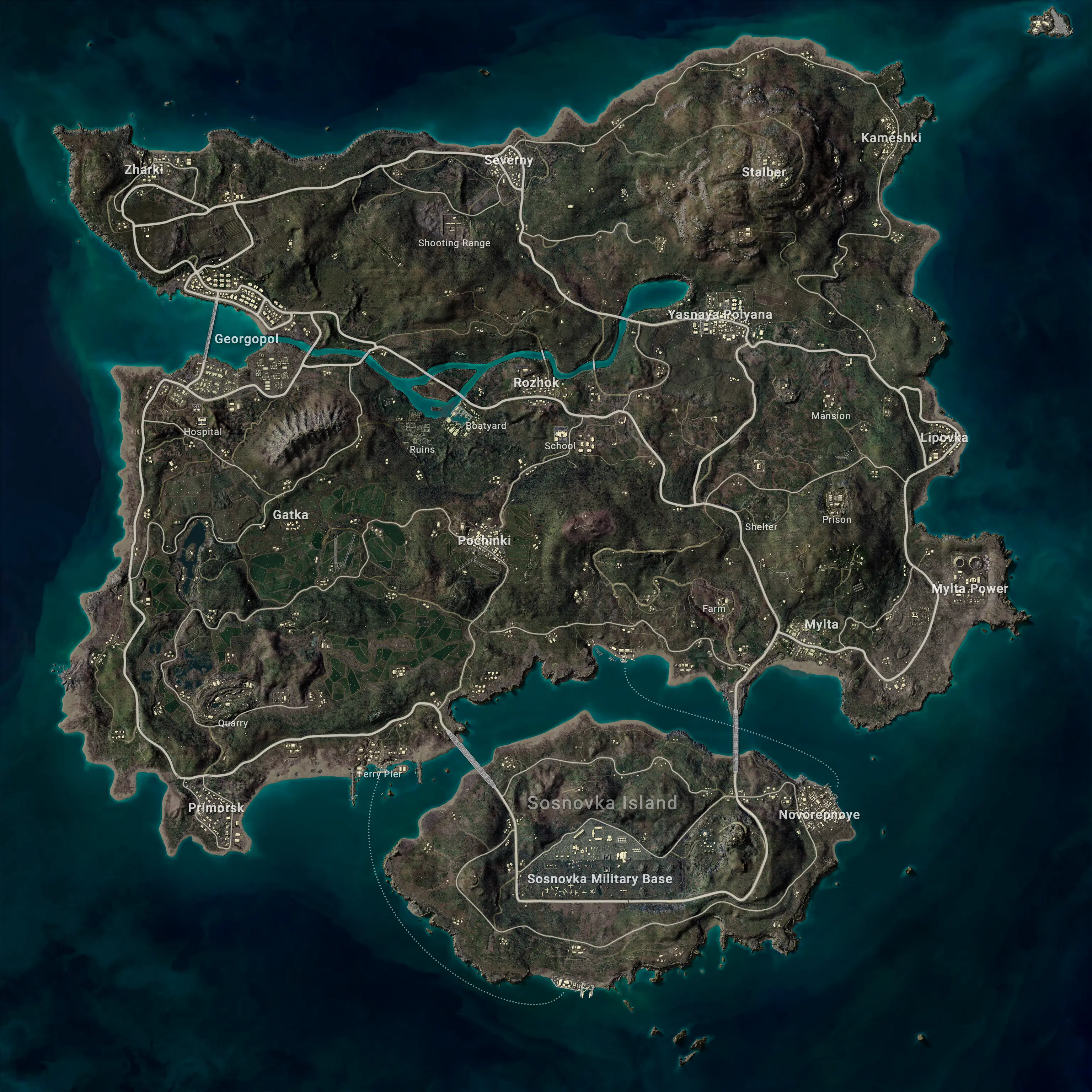
Aerial survey — Kun Xia, Rondo. The species' preferred nesting ground: 3x the human landing rate.PUBG.ARMY WILD
8:00 UTC. The servers are quiet. Most of the humans have gone to bed, and the matchmaker does what it always does when the queue runs thin: it opens the gates. At this hour, 38.1 percent of every lobby is machine. The doors of the plane fold open over the Baltic coast, and the species pours out.
You have played against it a thousand times. You may have thanked it for the free kill. But watched closely — across 7,331 recorded aliases and a 24.8% share of every seat in the sample — the animal turns out to be stranger, gentler and more orderly than its reputation. What follows is the first full natural history of Robotus pubgensis.
Chapter I
The five species
Every census begins with counting, and the count holds a surprise: the bot you remember — the one that sprints into your crosshair and dies immediately — is the rarest form the species takes. Five behavioral variants emerge from the record, and the commonest of them would not hurt a fly, statistically speaking.
FIG. 1 — The five species
258,743
specimens observed
24.8%
of normal lobby seats
7,331
known aliases
25
confirmed victories
PLATE I
The Common Wanderer
Robotus errans
65.2%
of population
By far the dominant species. Walks about a kilometre, deals a lifetime average of 24 damage, and in due course perishes. Harmless. Do not be alarmed.
Avg lifespan20:09Range1.2 kmAvg damage24
PLATE II
The Opportunist
Robotus opportunus
15.5%
of population
Takes exactly one life per lifetime, then permanently retires from violence. Science cannot yet explain why it stops.
Avg lifespan25:13Range1.9 kmAvg damage120
PLATE III
The Quiet Survivor
Robotus superstes
9.6%
of population
Reaches the top ten without hurting anyone, by the simple strategy of out-walking the field — it travels farther than any other species. Wins nothing, outlives almost everyone.
Avg lifespan25:54Range2.6 kmAvg damage24
PLATE IV
The Hunter
Robotus venator
6%
of population
The only genuinely dangerous variant: two or more kills per lifetime, the longest lifespan of the five — and it still finishes around 20th.
Avg lifespan28:02Range2.3 kmAvg damage222
PLATE V
The Lemming
Robotus praeceps
3.7%
of population
The rarest of the five, despite carrying the whole species' reputation. Lands, walks 225 metres, deals 8 damage, and is gone inside seven minutes.
Avg lifespan6:17Range225 mAvg damage8
Chapter II
A day in the life
The Common Wanderer wakes on the cargo ramp of an aircraft it did not board. What follows is a routine of remarkable consistency: a walk of about 1.2 kilometres, conducted with no particular urgency toward no particular destination, lasting on average 20:09. It bothers no one. The curve below shows the strangest fact in this guide — the species outlives its predators.
FIG. 2 — The lifecycle
Bots Humans
Cumulative survival of the two populations. At minute 10 of a match, 90.7% of bots are still alive against 50.5% of humans — the species does not die young. It dies late, and almost never on its own terms.
FIG. 3 — Activity rhythm
38.1%
00:0006:0012:0018:0023:00 UTC
The species is most abundant at 8:00 UTC (38.1% of seats), when humans are scarce and the machine fills empty chairs — and rarest at 18:00 UTC (19.5%), when the humans come home.
Chapter III
The hunt
Of 156,438 recorded human deaths since individual identification began, only 121 were the work of a bot. When one does kill, the signature is unmistakable — and its weapon of choice, by the record, is the Frag Grenade.
FIG. 4 — Identification in the field
Field mark
The bot
The human
Average kill distance
19 m
45 m
Kills at point-blank (under 10 m)
71.1%
26.4%
Headshot rate
14.9%
25.8%
Distinct weapons used
39
131
Favored weapons
Frag Grenade · Beryl M762 · AKM
AUG · M416 · MP5K
FIG. 5 — Myths vs. the record
Three things everyone knows about bots. Two collapse on contact with 9 days of records — and one survives, triumphantly. Raw count shown for the bot population; rates compare bot vs. human per 100 individuals.
They really don't drive
7
per 100 specimens: 0 vs 196.5
They do revive each other
3,269
per 100 specimens: 5.9 vs 26.2
They do heal
1,774,346
HP per specimen: 32 vs 95
FIG. 6 — Notable specimens
Longest confirmed kill by a bot
198 m
Specimen "osborneyouth" connected with a Kar98k on Taego — genuine sniper range, from a creature that usually hunts at 20 metres. Respect is owed.
Deadliest single outings
“YuanpostMaturity”2 human kills · Frag Grenade · Taego
“Voyd95”2 human kills · Beryl M762 · Taego
“Yuridiyi”1 human kills · AKM · Erangel
“nOvelTYcOlUmnIst”1 human kills · Mini14 · Paramo
“kekaoerzi”1 human kills · MP5K · Sanhok
Bot identities exist only within a single lobby (their ids are seat numbers), so records are per outing, identified by alias.
For every human a bot kills, humans kill 285 bots.
Chapter IV
Range & nesting
Drop a thousand humans over a map and they pile into the same few towns, for the fights. Drop the species and it drifts elsewhere — to the quiet fields and forgotten compounds. Its favorite nesting ground, Kun Xia on Rondo, sees bots at 3 times the human landing rate. The places it avoids are the ones humans crowd into — starting with Novorepnoye.
Aerial survey — Novorepnoye, Erangel. Shunned by the species at 0.41x the human rate; humans die here in numbers.PUBG.ARMY WILDFIG. 7 — Favored nesting sites / Shunned by the species
Favored nesting sites
Kun Xia · Rondo3x human rate
Airport · Taego2.9x human rate
Stadium · Rondo2.83x human rate
Go Dok · Taego2.44x human rate
Song Am · Taego2x human rate
Georgopol · Erangel1.93x human rate
Shunned by the species
Novorepnoye · Erangel0.41x human rate
Los Leones · Miramar0.46x human rate
Power Grid · Miramar0.49x human rate
The species avoids exactly the places humans fight over. It did not get the hot-drop memo, and it is thriving.
FIG. 8 — Landing survey — bots vs. humans
Bot landings Human landingsDot size scales with landings per grid cell.
FIG. 9 — Favorite grounds, map by map
The locations the species likes most on each map — by share of all bot landings there. Not the same thing as out-landing humans: these are simply where you will find them.
Erangel14,857 landings
1 Mylta5.5%
2 Pochinki3.7%
3 Hospital2.8%
Taego9,485 landings
1 Hosan Prison5.4%
2 Oh Hyang3.9%
3 School3.5%
Vikendi6,993 landings
1 Cement Factory3.8%
2 Zabava3.3%
3 Mount Kreznic3.1%
Rondo6,819 landings
1 NEOX Factory3.9%
2 Mey Ran3.5%
3 Tin Long Garden3.3%
Sanhok6,259 landings
1 Pai Nan3.5%
2 Cave3.4%
3 Temple2.9%
Miramar5,041 landings
1 Chumacera4.5%
2 Water Treatment3.2%
3 San Martin3%
FIG. 10 — Habitat density
Share of lobby seats held by bots, per map — normal public matches only.
Rondo
45.7%
Deston
36.6%
Vikendi
32.6%
Paramo
30.7%
Miramar
30.7%
Taego
24.1%
Sanhok
22.9%
Karakin
20.4%
Erangel
18.8%
Range
0%
Chapter V
Society
The species is social, but strictly apart. It arrives wearing one of 7,331 recorded aliases — a pelt engineered to pass as human, though the pattern gives it away — and it keeps to its own: in the entire record, not one mixed bot-human squad appears. The herds are pure. 14.4% of observed squads were bot from top to bottom, and they do look after each other — the revive log proves it.
FIG. 11 — Herd structure
Composition of 127,701 observed squads in squad queues. The record shows a strict rule: herds are pure. No mixed bot-human squad has ever been observed — the 0% below is the finding, not an error.
0.55
Avg bots per squad
0%
Mixed squads
14.4%
All-bot squads
FIG. 12 — Naming conventions
The species wears 7,331 known aliases, generated to pass as human — but the pelts follow rules. The name alone is a field mark:
A random sample from the archive. If your duo partner is on this list, we have news.
FIG. 13 — Field identification service
Check any name against the archive of every recorded alias — was your teammate one of them?
Checks the roster archive of every tracked match this season and beyond. Verdicts reflect the record, not the soul.
Chapter VI
Death & legacy
How does it end? At human hands, almost without exception: 91.9% of the species dies by gunfire, farmed as the round tightens. The weather claims only 7.1% — though even here the animal distinguishes itself, walking into the storm at twice the human rate of 3.3%. It does not run from the blue wall with any conviction. It has somewhere to be, and it is in no hurry to get there.
FIG. 14 — Causes of death in the wild
PUBG's own cause-of-death record, per population — including how much of each simply walks into the weather.
Violence (shot by a player)bots 91.9% · humans 95.2%
For every human a bot kills, humans kill 285 bots. It is not a fair trade and the bots have not noticed.
Damage flows (HP)
Humans → bots3,271,390
Bots → humans158,656
Bots → bots2,746,590
Every ecosystem has an energy pyramid, and Robotus sits at its base: for every hundred human match-seats, 21.6 bots are harvested. The species' ecological role is, bluntly, forage.
FIG. 16 — The victory case file
It has happened 25 times: a bot placed first in a normal public match. Forensics on the winners overturns the obvious theory — these were not lucky pacifists. Champions averaged 1.8 kills, Hunter behavior in a population that averages almost none; only 20% closed the match without a kill. When the species wins, it wins like a predator.
25
Recorded victories
20%
Won with zero kills
16:04
Avg winning lifespan
A bot is 136 times more likely to kill another bot than to kill you.
Epilogue
Conservation status
At 18:00 UTC the humans come home, the queues fill, and the species thins to 19.5 percent — pushed to the margins of its own habitat. It will be back by morning. It always is.
FIG. 17 — Population census, day by day
Share of normal-lobby seats held by the species, each day this season. The matchmaker giveth as the humans log off.
IUCN-style assessment · Robotus pubgensis
LCNTVUENCREWEX
Least Concern
Population stable at 24.8% of all normal-lobby seats and replenished nightly by the matchmaker. Principal threat: humans with mid-tier assault rifles. Conservation action required: none. The species is doing fine. It is, in fact, the only one of us guaranteed a seat in the next match.
Field methodology
Bots are identified by PUBG's own account ids ('ai.' prefix — every lobby seat carries one). Population figures cover normal public BR matches only, using the same casual/ranked classification as the Bot Census. Species are behavioral buckets over each specimen's official per-match scoreboard. Kill and usage marks come from telemetry rows collected since 8 July 2026, when individual tagging (account ids on kill records) began — vehicle counts exclude parachutes and the drop plane.
No specimens were harmed in the making of this guide. They respawn in the next lobby regardless.